
By Dianne Witte
The 2024 Paris Olympics are now in the rear-view mirror. But there is still time to reflect on the implications and messages it contains for the New Age. The opening ceremony especially communicated several remarkable events and “firsts” to be recorded alongside the athletic accomplishments.
The opening ceremony of the Olympic Games traditionally offers the host city the opportunity to celebrate sporting excellence and international unity while also presenting to the world a flattering portrait of its own nation, informed by its own culture. Directed by Thomas Jolly, it was a truly visionary, gold medal winning effort reflecting French love of history, music and art in a most creative fashion. Remarkably, the opening ceremony was held outside of a stadium for the first time in modern Olympic history.
As a result, French National Orchestra played in the rain next to the Eiffel Tower. The players, much like many of the spectators, were dressed in plastic ponchos to survive the night’s downpours, but their instruments were left exposed to the rain. Later reports reveal, because they were doing it outdoors, it was prerecorded. Artists mimed with less valuable instruments serving as props.
A masked torchbearer was the main protagonist of the opening ceremony, serving as a connecting thread throughout. The character made appearances between segments in pre-recorded scenes, live on the Seine, the rooftops of Paris, and the city’s landmarks. The torchbearer represented several masked French heroes, as well as the Olympic spirit and a diversity of characteristics of French culture.
Opening with Hymn to Love, written by the popular and famous French musician Edith Piaf and performed by Celine Dion, the program, which was divided into twelve acts reflecting the culture of France and its history, took place sequentially at Paris landmarks such as Notre Dame, Conciergerie, Musée d’Orsay, and the Eiffel Tower. It featured musical performances by French and international musicians.
Historical vignettes began in the first sequence, with a welcome, Enchanté, (Nice to Meet You) featuring Lady Gaga.
The second sequence, Synchronicité, (Synchronicity) started with a dance tribute to the reconstruction teams of Notre-Dame repairing the cathedral following its 2019 fire.
In the third sequence, Liberté, Gojira performed ‘Ah, Ça Ira!’ (‘It’ll be fine’), a song that was popular during the French revolution. Gojira was the first metal band to ever perform during an Olympic opening ceremony. Their performance followed portions dedicated to Les Misérables and Marie Antoinette.
The Republican Guard marching band opened the fourth sequence, Égalité (Social Equality).
The fifth sequence, Fraternité, (Fraternity (philosophy)) referenced the 1911 theft of Leonardo da Vinci’s Mona Lisa from the Louvre.
The sixth sequence, Sororité (sisterhood), highlighted ten notable French women with golden statues along the Seine.
In the seventh sequence, Sportivité, (Sportsmanship) the parade of athletes on boats resumed. Athletes demonstrated urban sports, namely skateboarding and BMX freestyle, on floating ramps.
The eighth sequence, Festivité, included the controversial sequence in which a nearly nude and painted in blue Dionysus (the Greek god of wine and celebration in Greek mythology), appeared in tribute to France’s wine industry and the ancient Greek Olympics). The performance of “Nu”, with Dionysus lying at the center of a long table, with the drag queens posed in a sort of Bacchanalian feast, alluded to the relationship between Dionysus and his daughter Sequana, the goddess of the Seine.
The ninth sequence, Obscurité (Darkness), continued with the music turning darker in mood. An LED lit floor flashed a montage of various climate disasters, including droughts, floods, and forest fires, while dancers slowly collapsed, one by one. Then, Juliette Armanet appeared on a raft singing “Imagine” as part of a call for change.
The tenth sequence, Solidarité, showcased a masked horse rider representing a patron saint of France Joan of Arc and the goddess of the river Seine, Sequana spreading the spirit of the Games. This segment referenced Pierre de Coubertin, known as the father of the modern Olympic Games, the history of the Olympics was explored with numerous archival images and highlights of past Games.
During the eleventh sequence, Solennité, President Emmanuel Macron declared the Games open.
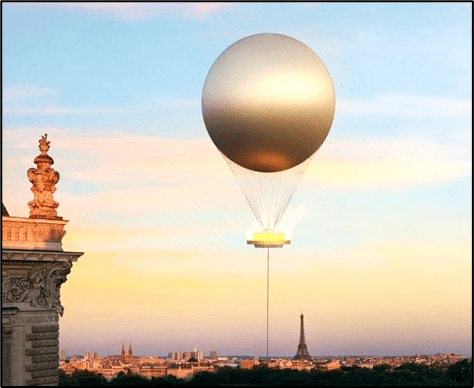
The ring of fire, almost [23 feet] in diameter, incorporates 40 LED spotlights to illuminate the cloud created by 200 high-pressure misting nozzles. Remarkably all that of electricity and water rose 200 feet above the ground, when the Cauldron was in flight. The cauldron is attached to a wire-like conduit anchored in the middle of the Grand Bassin Rond to avoid flying off; the conduit fed the cauldron with water and electricity, and was pulled back to the ground during daytime. It is the first Olympic cauldron to light up without the direct use of fossil fuels.
Finally, Céline Dion, accompanied by pianist and musical director Scott Price, concluded the opening ceremony by singing Édith Piaf’s “Hymne à l’amour” from the first floor of the Eiffel Tower, bringing the ceremony to a close. This was Dion’s first time taking to the stage in over four years, following her being diagnosed with Stiff Person Syndrome.
What an outstanding combination of history, music and art creatively interwoven in one truly remarkable event.
Another remarkable event you may have missed took place at the women’s beach volleyball final between Brazil and Canada when a dispute arose between the respective teams. But the situation was quickly de-escalated after the referee intervened and separated them. To help calm the apparent tense moment between the two teams, the event’s DJ played Lennon’s “Imagine” once the players returned to their starting positions. The players, initially caught up in the heat of the moment, began to smile and relax, while the crowd joined in a spontaneous sing-along. Awesome, “imagine” the visionary idea of having music resolve disputes rather than violence. Now that’s a new age concept we can use.
As these Olympics move from the City of Lights to the City of Angels in 2028, we have to wonder can LA match or exceed this highly creative production reflecting the best of the Aquarian Age, so far? My next question is will there be a non-competitive Olympic event featuring Cooperation and/or Compassionate Service?
 Visionary Viewpoints
Leave a comment